Sewage Spill in the Potomac River

Aguapotable Cierre ♦ de mariscos Recreación

On January 19, a sewer line in Montgomery County, Maryland, collapsed, causing an overflow of more than 200 million gallons of wastewater into Potomac River. On January 24, DC Water completed a bypass to reroute wastewater around the collapsed section of pipe and back into the sewer system.

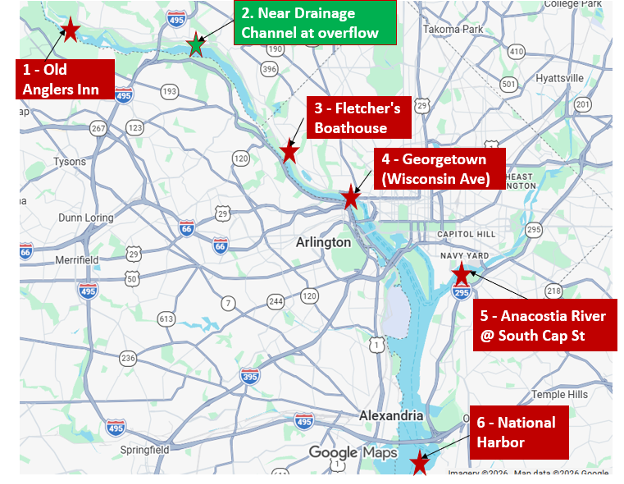
Este mapa muestra la ubicación de la descarga de aguas residuales junto con otros cinco lugares a lo largo del río Potomac donde DC Water recogió muestras de bacterias
Este mapa muestra la ubicación de la descarga de aguas residuales junto con otros cinco lugares a lo largo del río Potomac donde DC Water recogió muestras de bacterias. Mapa cortesía de DC Water.

DC Water is handling the repairs to the pipe. Updates on repairs can be found on the DC Water page

Maryland has regulatory authority over the Potomac River for issuing shellfish closures and recreational advisories as well as water quality monitoring.

The Virginia Department of Health (VDH) is working with the Maryland Department of the Environment (MDE) and the Maryland Department of Health (MDH). VDH has a long-standing relationship with these agencies navigating pollution events and water quality monitoring in the Potomac River and have been in constant communication since the event occurred.

On February 13, VDH issued a recreational advisory for Virginia residents.

Agua potable

DC Water has stated its drinking water is NOT affected by this incident.

La localidad más cercana de Virginia que emplea el río Potomac como fuente principal de agua es Fairfax. La captación del río Potomac de Fairfax Water se encuentra a varios kilómetros río arriba de donde el vertido de aguas residuales entra en el Potomac y, por tanto, no se ve afectada.

Cierres de mariscos

El MDE, en respuesta al derrame, emitió el cierre de las zonas de cultivo de moluscos de Maryland el 25 de enero desde el lugar del vertido hasta el puente Harry W. Nice (Dahlgren) (Ruta 301). Este cierre incluye el río Potomac desde el condado de Charles y las zonas limítrofes con Virginia, extender desde la región del río Port Tobacco hasta el puente Harry W. Nice (Dahlgren) (Ruta 301). Por el momento, MDE y VDH no tienen evidencia de que los recursos de mariscos fuera del área de cierre de emergencia definida se vieron afectados.

El MDE, en respuesta al derrame, emitió el cierre de las zonas de cultivo de moluscos de Maryland el 25 de enero desde el lugar del vertido hasta el puente Harry W. Nice (Dahlgren) (Ruta 301). Este cierre incluye el río Potomac desde el condado de Charles y las zonas limítrofes con Virginia, extender desde la región del río Port Tobacco hasta el puente Harry W. Nice (Dahlgren) (Ruta 301). Por el momento, MDE y VDH no tienen evidencia de que los recursos de mariscos fuera del área de cierre de emergencia definida se vieron afectados.
Este mapa muestra la ubicación del aviso de mariscos. Mapa cortesía de MDE.

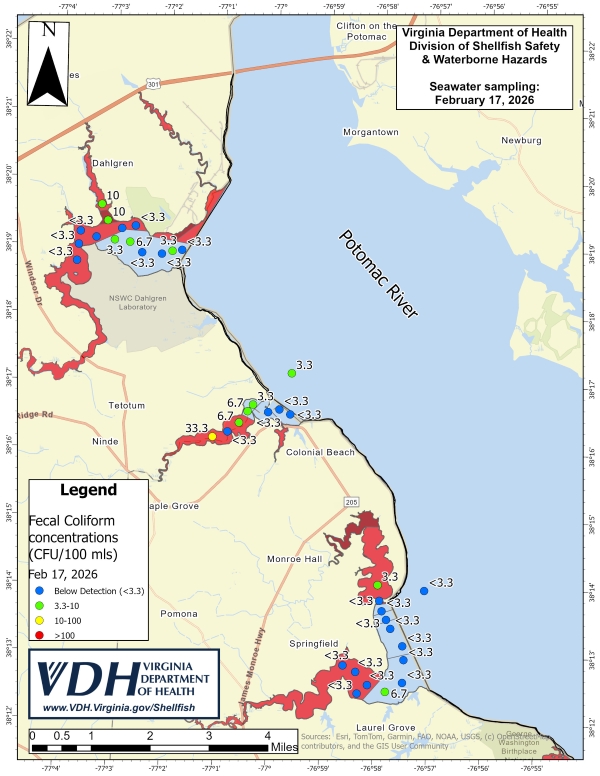
Las aguas de recolección de moluscos bajo la jurisdicción de Virginia comienzan en el puente Harry W. Nice (Dahlgren) (Ruta 301) y se limitan a arroyos afluentes situados en el lado de Virginia del río Potomac. Actualmente, las zonas de cultivo de mariscos de Virginia no se ven afectadas por el vertido de aguas residuales. Como resultado, hasta la fecha no se realizaron inspecciones ni pruebas de calidad del agua relacionadas con este incidente.

Recreación

Due to reports of sewage spills in the Potomac River and the anticipated timeline for repairs, the VDH is issuing a recreational water advisory for Virginia residents. For the safety of people and pets, VDH is advising Virginia residents to avoid recreational water activities in the Potomac River, such as swimming, wading, tubing, white-water canoeing or kayaking, where full-body submersion is more likely to occur.

The advisory is being issued out of an abundance of caution due to a sewage spill in the Potomac River that occurred January 19, and subsequent reports of a sewage discharge February 7. The timeline for the repair is estimated to be four to six weeks.  The advisory area extends for 72.5 miles from the American Legion Memorial Bridge (I-495) in Fairfax County to the Governor Harry W. Nice Memorial Bridge (Route 301) in King George County.

The advisory area extends for 72.5 miles from the American Legion Memorial Bridge (I-495) in Fairfax County to the Governor Harry W. Nice Memorial Bridge (Route 301) in King George County.

To prevent recreational water illnesses due to exposure to sewage spill events, people should:

  • Avoid contact with water in the advisory area and observe advisory signage posted at waterbody access points.
  • Avoid any area of the water body where water has a foul odor, dead or dying fish, or discolored water.
  • Lave la piel de inmediato con agua y jabón si no puede evitar el contacto con el agua en las proximidades.
  • Enjuague o lave los artículos que entran en contacto con el agua, incluida la ropa, el equipo de pesca, los chalecos salvavidas, las cuerdas y los remos.
  • Busque atención médica y notifique a su médico sobre la exposición al cuerpo de agua si experimenta efectos adversos para la salud después del contacto con el cuerpo de agua.
  • When harvesting fish or crabs, discard skin, organs, cook the meat to proper temperature, and clean cutting boards and cutting implements with warm soapy water.

For more information on recreational water safety, visit www.SwimHealthyVA.com.


Última actualización: 14 de febrero de 2026