As of August 18, it has been more than 42 days since an outbreak-associated measles case has been reported in Virginia. As such, VDH has formally declared that the measles outbreak in Buckingham and Cumberland Counties has ended. Measles continues to spread at increased rates in the U.S. and globally. Vaccination continues to be the best way to prevent measles and future outbreaks.
Sobre el sarampión
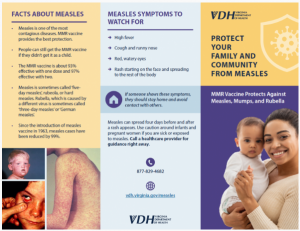
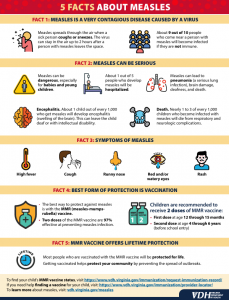
El sarampión es una enfermedad viral altamente contagiosa que se propaga fácilmente por el aire cuando una persona infectada respira, tose o estornuda. El virus puede permanecer en el aire hasta dos horas después de que la persona infectada abandone la zona. Los síntomas del sarampión incluyen tos, mocos, erupción y a veces ojos rojos y con picor. El sarampión se puede prevenir mediante una vacuna vírica vírica vírica vírica segura y eficaz. Se gestionan dos dosis de la vacuna para proporcionar una protección duradera.
En 2025 y hasta la fecha en 2026, Virginia ha experimentado un aumento de casos de sarampión. Estos casos han sido el resultado de viajes (internacionales y nacionales) y exposición en el hogar/contacto cercano (p. ej., transmisión de un miembro de la familia a otro). El 1de mayo3, 2026, Virginia confirmó un brote de sarampión en el condado de Buckingham. Un brote se define como tres o más casos relacionados entre personas que no pertenecen al mismo hogar. El 25 de junio de 2026, Virginia amplió geográficamente el brote para incluir el condado de Cumberland. El 18 de agosto de 2026, el VDH declaró formalmente que el brote de sarampión en los condados de Buckingham y Cumberlandha finalizado.
Para obtener más información sobre el virus del sarampión, visite la página de información sobre el sarampión .
2026 Respuesta ante el sarampión en Virginia
2026 Casos de sarampión en Virginia
Los datos son preliminares y están sujetos a cambios conforme se reciban datos adicionales.
2026 Casos de sarampión por grupo de edad o región sanitaria
2026 Características de los casos de sarampión
2026 casos de sarampión por localidad
Utilice este mapa de VDH para encontrar su distrito de salud local.
Los datos de aguas residuales para el sarampión en Virginia se pueden consultar en el sitio web. Programa de monitoreo de aguas residuales de los CDC sitio.
VDH emite notificaciones cuando una investigación identifica un momento y lugar específicos donde alguien con sarampión pudo haber estado en un entorno público.
Qué hacer si usted estuviera expuesto:
- Monitoree los síntomas: Si usted estuvo expuesto, especialmente si no está inmunizado por vacunación o infección previa, esté atento a síntomas de sarampión.
- Reporte su exposición: Complete esta encuesta breve Para notificar a su departamento de salud local. Los funcionarios de salud pública se pondrán en contacto con usted si se necesitan medidas adicionales.
- Si usted experimenta síntomas de sarampión: Contacte con un proveedor sanitario de inmediato. Llame con anticipación antes de ir al consultorio de su proveedor de atención médica o a la sala de emergencias. Dígale que puede haber estado expuesto al sarampión y pídale que se comunique con el departamento de salud local. Esto ayuda a proteger a otros pacientes y al personal.
Sitios de exposición activa:
Lugares de exposición pública:
| Ubicación | Fecha y hora | Último día de observación de síntomas |
|---|---|---|
| No hay sitios de exposición activos. | ||
La tabla se actualizará cuando se identifiquen exposiciones adicionales. Última actualización: 8 de septiembre de 2026.
Notas importantes:
- El riesgo de exposición se limita a las fechas y horas específicas anunciadas. Una vez transcurrido ese periodo, el lugar ya no supone un riesgo continuo de exposición al sarampión.
- Las empresas y ubicaciones enumeradas no son responsables de la presencia de alguien con sarampión.
- En algunas situaciones, una persona con sarampión podría visitar un lugar, como un centro de cuidado infantil o un consultorio médico, donde existe una población definida. Esto significa que todas las personas que podrían haber estado expuestas pueden ser identificadas y notificadas directamente. En estas situaciones, se actualizará el recuento de casos de sarampión en el sitio web del Departamento de Salud de Virginia (VDH, por sus siglas en inglés) , pero no se incluirán otros lugares públicos de exposición en la lista.
Los residentes de Virginia que tengan preguntas sobre el sarampión pueden enviar un email al Departamento de Salud de Virginia a epi_response@vdh.virginia.gov o contactar con su Departamento de Salud Local.
- 27 de agosto: Funcionarios de salud pública de Virginia investigan una posible exposición al sarampión en el norte de Virginia
- August 19: Updates on Measles Outbreak and Vaccine Recommendations in Virginia
- Junio 26: Expansión del brote de sarampión e inmunizaciones de regreso a clases
- 25 de junio: El Departamento de Salud de Virginia amplía el área del brote de sarampión para incluir el condado de Cumberland
- Junio 20: Funcionarios de salud de Virginia investigan la exposición al sarampión en el norte de Virginia.
- 29de mayo: Funcionarios de salud de Virginia investigan otra exposición al sarampión en la región central
- Mayo 28: Funcionarios de salud de Virginia investigan una exposición al sarampión en la región central.
- 26 de mayo: Monitorización de aguas residuales de sarampión
- 22de mayo: El Departamento de Salud de Virginia lanza un panel de control sobre el sarampión ante el aumento de casos y brotes de sarampión
- Mayo 13: Brote de sarampión en el condado de Buckingham
- 9de mayo: Funcionarios de Salud de Virginia investigan un caso de sarampión en la Región Central
- 1 de mayo: Funcionarios de salud de Virginia investigan una posible exposición al sarampión en el norte de Virginia
- 21 de abril: Oficiales de salud de Virginia investigan dos casos confirmados de sarampión en la región noroeste
- 4de marzo: Funcionarios de salud de Virginia investigan una posible exposición al sarampión en la región suroeste
- 19de febrero: Funcionarios de salud de Virginia investigan dos casos confirmados de sarampión en el norte de Virginia
- 16de febrero: Funcionarios de salud de Virginia investigan caso confirmado de sarampión en la Región Norte
- 6de febrero: Funcionarios de salud de Virginia investigan un caso confirmado de sarampión y una exposición en la Región Norte
- 4 de febrero: Las autoridades sanitarias de Virginia investigan un caso confirmado de sarampión en la región norte
- Enero de 30: Funcionarios de salud de Virginia investigan una posible exposición al sarampión en el norte de Virginia
- Enero de 20: Funcionarios de salud de Virginia investigan otro caso confirmado de sarampión en la Región Norte
- Enero de 11: Funcionarios de salud de Virginia investigan un caso confirmado de sarampión en la Región Norte
- Los paneles se actualizan los martes y jueves alrededor del mediodía.
- Un caso se refiere a una infección por sarampión reportada en un residente de Virginia.
- Se definen los casos Usando un sistema estandarizado Definición de caso. Los casos se confirman por tener positivo en pruebas de laboratorio o síntomas similares al sarampión y contacto conocido con un caso confirmado. Los casos asociados al brote se confirman empleando definiciones específicas del brote, que pueden incluir un uso ampliado de criterios de vinculación.
- Un Brote Is definidos como tres o más casos relacionados entre contactos no familiares. VDH determina que un brote se ha expandido geográficamente cuando las investigaciones de salud pública detectan evidencia de transmisión comunitaria en la nueva área geográfica.
- La fecha empleada Para este panel de control, la fecha en que comenzó la erupción es la siguiente. Si esa fecha no está disponible, se emplea la fecha del evento. La fecha del evento se calcula empleando la fecha de recolección de la muestra del laboratorio asociado más antiguo, si está disponible, o la fecha de inicio de la enfermedad, si está disponible, o la fecha del diagnóstico. Si ninguna de estas fechas está disponible, se revisan fechas adicionales para su uso. La fecha que se emplee puede cambiar a medida que obtengamos más información. Las fechas pueden diferir de Página de Sarampión y Brotes de los CDC.
- Semanas se exhiben de domingo a sábado.
- Edad es la edad del paciente en el momento de la aparición de la enfermedad.
- Para obtener un mapa de las regiones de planificación de salud y los distritos de salud de Virginia, visite el Distritos Sanitarios Locales de VDH página.
- Casos de sarampión no asociados con el internacional Viajar incluye pacientes con historial de viaje desconocido, aquellos que reportaron viajes nacionales y aquellos que no reportaron ningún historial de viaje.
- Estado de vacunación si el paciente alguna vez recibió una vacuna contra el sarampión.
- hospitalización Indica si el paciente fue ingresado en el hospital por esta enfermedad.
- Muerte direcciones si el paciente fallecía por su enfermedad de sarampión.
Preguntas frecuentes (FAQs)
¿Cuáles son los síntomas y complicaciones del sarampión?
Los síntomas del sarampión suelen aparecer en dos fases. Aproximadamente 7 entre y 14 días luego de la exposición al sarampión, comienzan los primeros signos y síntomas de la enfermedad. Entre ellos se incluyen fiebre superior 101 a grados, mocos, ojos rojos y llorosos y tos. También pueden verpequeñas manchas blancas, llamadas manchas de Koplik span class="">en las encías y el interior de las mejillas. Estos pueden aparecer pocos días después de que aparezcan losprimeros síntomas.
La segunda fase de la enfermedad comienza 3 a 5 días (de 1 a 7 días) después. En esta etapa, un sarpullido comienza en la cara y se extiende al resto del cuerpo.
Aunque muchos pacientes se recuperan del sarampión, algunos experimentan complicaciones graves, como Neumonía, encefalitis, sordera, u otro Infección grave debido a Daño al sistema inmunitario.
- Uno de cada cinco pacientes con sarampión requerirá hospitalización.
- Uno de cada veinte niños con sarampión desarrollará neumonía, la causa más común de muerte por sarampión en niños pequeños.
- Entre Uno y tres de cada 1mueren000 niños con sarampión por complicaciones.
- La probabilidad de muerte (por cualquier causa) aumenta en los años inmediatamente posteriores a una infección de sarampión debido a la capacidad del virus del sarampión para borrar la memoria inmune.
¿Tengo protección contra el sarampión?
Tú eres considerado inmune o protegida contra el sarampión si tienes alguna de las siguientes condiciones:
-
- Recibió el Número recomendado de vacunas que contienen el virus del sarampión Según tu edad y el riesgo de exposición (ver "¿Cómo encuentro mi historial de vacunación?”).
- Un análisis de laboratorio confirmó que tuviste sarampión en algún momento de tu vida o que eres inmune al sarampión.
- Usted nació antes de 1957.
Creo que estuve expuesto al sarampión. ¿Qué debería hacer?
El VDH emite notificaciones rápidamente cuando una investigación identifica un momento y lugar específicos en el que alguien con sarampión pudo estar en un lugar público. Si estuviste expuesto al sarampión:
- Comprueba si estás protegido. Tú eres considerado inmune o protegida contra el sarampión si tienes alguna de las siguientes condiciones:
- Recibió el Número recomendado de vacunas que contienen el virus del sarampión Según tu edad y el riesgo de exposición (ver "¿Cómo encuentro mi historial de vacunación?”).
- Un análisis de laboratorio confirmó que tuviste sarampión en algún momento de tu vida o que eres inmune al sarampión.
- Usted nació antes de 1957.
- Informa de tu exposición. Los funcionarios de salud pública se comunicarán con usted si se necesitan medidas adicionales o si usted podría ser elegible para medicamentos posteriores a la exposición que pueden te protegen de contraer sarampión o reducen la gravedad de la enfermedad si contraes sarampión.
- Vigila los síntomas durante 21 días. Esto es especialmente importante si no eres inmune por vacunación o infección previa. (Ver "¿Cuáles son los síntomas y complicaciones del sarampión?")
- Si experimentas síntomas de sarampión, contacta con un profesional sanitario de inmediato. Llama antes de ir a la consulta del médico o a urgencias. Dígales que puede estar expuesto al sarampión y pídales que Contacta con el departamento de salud local. Esto ayuda a proteger a otros pacientes y al personal. Llama 9-1-1 si es una emergencia médica.
- Si lo eres inmunodeprimidos, consulta con tu profesional sanitario si tienes dudas o desarrollas síntomas.
- Si no eres inmune, deberías mantenerte alejado de los demás hasta que tu proveedor sanitario te diga que puedes volver a tus actividades normales. Esto es especialmente importante si vas a entrar en entornos con personas vulnerables, como escuelas, hospitales y guarderías.
¿Qué es una prueba de titulación de anticuerpos contra el sarampión y cuándo es necesaria?
Un análisis de título de sarampión es un tipo de análisis de sangre. Se usa para ver si tienes inmunidad (protección) contra el sarampión. Una prueba de título del sarampión proporciona información sobre la presencia de anticuerpos contra el sarampión en la sangre. Tu cuerpo produce anticuerpos contra el sarampión luego de ser vacunado o infectado con el sarampión.
Las personas que estuvieron expuestas al sarampión y no tienen protección (inmunidad) podrían ser elegibles para recibir la vacuna triple viral y así proteger. Sin embargo, la vacuna triple vírica debe gestionar en un plazo de 72 horas tras la exposición para proporcionar protección.
Si tuviste una exposición reciente al sarampión y no tienes claro cuál es tu estado de vacunación contra el sarampión, es mejor recibir una dosis de la vacuna triple vírica en lugar de hacerse una prueba de título contra el sarampión. Hay varias razones para ello:
- La prueba de titulación lleva tiempo y es posible que los resultados no estén disponibles con la suficiente rapidez para orientar las medidas de salud pública destinadas a proporcionar protección tras una exposición.
- Puede que no siempre proporcione resultados precisos. La prueba se desarrolló basar en la presencia de anticuerpos en personas expuestas de forma natural al sarampión. Esto podría llevar a resultados más bajos en personas inmunes al sarampión mediante la vacunación.
- No hay ningún problema en recibir otra dosis de MMR si eres elegible. La vacuna triple vírica vírica (MMR) suele estar disponible fácilmente en las consultas de los proveedores sanitarios.
Si crees que estuviste expuesto al sarampión y no tienes claro cuál es tu estado de vacunación, por favor llama a tu profesional sanitario para hablar sobre qué plan de atención es el mejor para ti.
¿Qué tratamiento está disponible para el sarampión?
No existe ningún tratamiento específico que se dirija específicamente al sarampión. El tratamiento del sarampión es de apoyo y se centra en el alivio de los síntomas mientras el cuerpo combate el virus. Esto podría incluir líquidos, medicamentos para reducir la fiebre o el dolor, antibióticos para tratar infecciones bacterianas secundarias y suplementos de vitamina A gestionados bajo la supervisión de un profesional de la salud.
Si alguien sin inmunidad al sarampión está expuesto a una persona con sarampión, Profilaxis postexposición (PEP) puede gestionar para reducir la probabilidad de desarrollar sarampión o complicaciones graves derivadas del sarampión. Debido a que existe una ventana de tiempo muy estrecha durante la cual la PEP es eficaz para prevenir el desarrollo del sarampión, es importante que notifica al VDH de tu exposición Lo antes posible.
¿Cómo encuentro mi historial de vacunación?
Puedes ver, descargar e imprimir de forma segura tu historial de vacunación de Virginia en cualquier momento usando el Solicitar registros de inmunización portales electrónicos. También comprueba:
- Proveedores de vacunas anteriores. No olvides las visitas de vacunación que hiciste a los departamentos de salud pública o a las clínicas del barrio.
- Tu hogar y los registros familiares. Revisa tus papeles antiguos, incluidos libros para bebés y formularios escolares o de campamento.
- Otros Registros estatales o locales. Todos los estados y algunas ciudades tienen registros centralizados de registros de vacunación.
- Escuelas y colegios o en otras instituciones de educación superior a las que tú o tu hijo asistieran.
- Empleadores anteriores, incluyendo al ejército.
¿La mayoría de los virginianos están vacunados contra el sarampión?
Sí. La mayoría de los virginianos son inmunes al sarampión, ya sea por vacunación o por haberlo padecido anteriormente.
A fecha de 2026, la tasa de vacunación contra el sarampión en niños de infantil en Virginia es alta (95%). Sin embargo, hay comunidades en Virginia con tasas de vacunación más bajas. Estas comunidades tienen un mayor riesgo de brotes de sarampión. Muchas comunidades en todo el mundo y dentro de los EE. UU. experimentaron brotes de sarampión en los últimos años cuando las tasas de vacunación caen por debajo del 95%.
¿Es segura la vacuna contra el sarampión?
Sí. La vacuna triple vírica (sarampión, paperas y rubéola) fue autorizada y gestionada ampliamente en EE. UU. desde 1971. Décadas de uso de la MMR en todo el mundo demostraron que es seguro, eficaz y que no tiene evidencia de causar daños a largo plazo.
Antes de la introducción de la primera vacuna contra el sarampión, 400500 personas morían cada año por complicaciones del sarampión en Estados Unidos, y casi 50000 personas eran hospitalizadas anualmente por complicaciones del sarampión.
¿Dónde puedo vacunarme?
Contacta con tu proveedor sanitario. Si no tienes seguro o tienes seguro insuficiente, busca vacunas sin costo o baratas cerca de ti:
- Vacunas gratis para niños que cumplan los requisitos: Vacunas para niños (VFC)
- Póngase en contacto con su Departamento de Salud Local
- Encuentra un Centro de Salud Federalmente Calificado
¿Previene la vitamina A la infección por sarampión?
No. La vitamina A no previene la infección por sarampión. La vacunación es la única forma de prevenir el sarampión. La vitamina A puede gestionar bajo la supervisión de un profesional sanitario como parte de la atención de apoyo para personas con enfermedad grave de sarampión. El uso excesivo de vitamina A puede provocar toxicidad y causar daños en el hígado, huesos, sistema nervioso central y piel.
Evita tomar niveles altos de vitamina A si estás embarazada, ya que siempre ocurrió Vinculado a graves defectos congénitos.
Soy padre. ¿Qué debería saber sobre la vacuna contra el sarampión?
Se anima a los padres a comentar preguntas y preocupaciones sobre el sarampión y la vacunación con el proveedor sanitario de sus hijos. Los niños necesitan vacunas para mantener la inmunidad a nivel individual y poblacional. Las enfermedades prevenibles por vacuna siguen siendo comunes en otras partes del mundo, y algunas son cada vez más comunes en EE. UU.
Se recomienda la vacuna triple vírica para todos los niños, empezando por el primera dosis a los 12-15 meses de edad, y una segunda dosis antes de que un niño entre en infantil (4-6 años). La segunda dosis puede gestionar antes, siempre que pasó al menos 28 días luego de la última dosis.
Bebés 6-11 meses de edad que vayan a viajar internacionalmente, o a un entorno de brote, también pueden recibir una dosis temprana de MMR. Habla con tu profesional sanitario o Departamento de Salud Local Si tienes un bebé de 611 meses y te interesa la MMR.
Estoy embarazada. ¿Qué debería saber sobre el sarampión?
¿Puedo ponerme la vacuna contra el sarampión mientras estoy embarazada?
No. Las vacunas de virus vivos, como la MMR, deberíanNo se le daría a personas embarazadas. La MMR debe gestionar al menos 28 días antes o luego del embarazo.
Si desea recibir la vacuna triple vírica (sarampión, paperas y rubéola) luego del embarazo, puede hacerlo sin riesgo durante la lactancia.
¿Qué debería hacer si no tengo inmunidad al sarampión y estuve expuesta a alguien con sarampión durante el embarazo?
Si un Persona no inmune embarazada si está expuesto al sarampión, generalmente se gestionaría inmunoglobulina (IG). La IG puede reducir la probabilidad de desarrollar sarampión o complicaciones graves del sarampión. La IG debe gestionar rápidamente tras la exposición, por lo que es importante que notificar al VDH y tu proveedor sanitario de tu exposición lo antes posible.
¿Los recién nacidos reciben protección contra el sarampión por parte de su madre durante el embarazo?
Los recién nacidos pueden estar protegidos contra el sarampión durante sus primeros meses de vida mediante anticuerpos maternos si la madre recibió la vacuna triple vírica o adquirió inmunidad natural contra el sarampión. Sin embargo, la protección contra el sarampión frente a anticuerpos maternos es muy variable y disminuye rápidamente. La IG se recomienda generalmente para bebés no inmunes expuestos, independientemente del estado inmunitario de la madre.
¿Qué debería saber sobre el sarampión antes de viajar?
- Se están produciendo brotes de sarampión. A nivel global y en partes de la Estados Unidos.
- Revisa tu destino y Aviso de salud para viajeros sobre el sarampión a nivel mundial de los CDC Para recibir consejos de salud de viaje y hablar con tu profesional sanitario si planeas viajar internacionalmente.
- Antes de viajar internacionalmente o a un Área del brote:
-
- Cerciórate de que todos estén protegidos contra el sarampión. (Ver FAQ: "Creo que estuve expuesto al sarampión. ¿Qué debería hacer?" - "Se te considera inmune o protegido contra el sarampión si...")
-
- Si necesitas vacunarte, pide cita al menos 2 semanas antes de salir.
-
- Los lactantes de 6 a 11 meses suelen recibir una dosis de la vacuna triple vírica vírica antes de viajar.
- Al volver, estate atento a los signos y síntomas del sarampión durante 3 semanas. Si tú o tu hijo enfermáis con un sarpullido y fiebre alta, llama a tu profesional sanitario y dile que viajasteis a una zona con propagación activa del sarampión.
Recursos sobre el Sarampión
Recursos escolares
Listas de verificación para la preparación
- Recomendaciones de VDH para Centros de Cuidado Infantil
- Recomendacionesdel VDH para las escuelas de K-12
- Recomendaciones de VDH para colegios y universidades